What separates GLP-1 from GLP-1(S) as research compounds?
GLP-1 and GLP-1(S) both act on the same target, the GLP-1 receptor (GLP-1R), a class B G-protein-coupled receptor that couples to Gs proteins and raises intracellular cAMP in cell culture models. They differ in what they are. GLP-1 is the native incretin peptide, used as the endogenous reference agonist. GLP-1(S) is a synthetic analog designed to resist enzymatic breakdown and to bind albumin, which is why the two behave so differently in a research setting even though they share a receptor.
The catalog describes the distinction in three points. GLP-1(S) has about 94% sequence homology to native GLP-1 7-36 amide, it carries an Aib substitution at position 8 that confers DPP-IV resistance, and it carries a C18 fatty di-acid chain at Lys26 that enables reversible albumin binding. Each of those points is a design change relative to the native sequence, and each maps to a specific experimental consequence discussed below.
What is native GLP-1?
Native GLP-1 is an incretin hormone cleaved from proglucagon in intestinal L-cells and in select brainstem neurons. The catalog entry refers to GLP-1 7-37, the biologically active form, and lists a molecular weight of 3337.73 g/mol and a formula of C151H226N40O46. Its CAS entry is given as 106612-94-6, labeled as GLP-1 7-37. In receptor pharmacology laboratories it serves as the reference agonist against which synthetic GLP-1R ligands are benchmarked in kinetic binding and functional cAMP assays.
Because it is unmodified, it also carries the liabilities of an unmodified peptide in biological media. It is a substrate for dipeptidyl peptidase IV (DPP-IV), which removes the N-terminal dipeptide and inactivates it. That limits the useful window of a native GLP-1 experiment to short incubations, and it is why many protocols that need sustained receptor engagement use a stabilised analog instead.
What is GLP-1(S)?
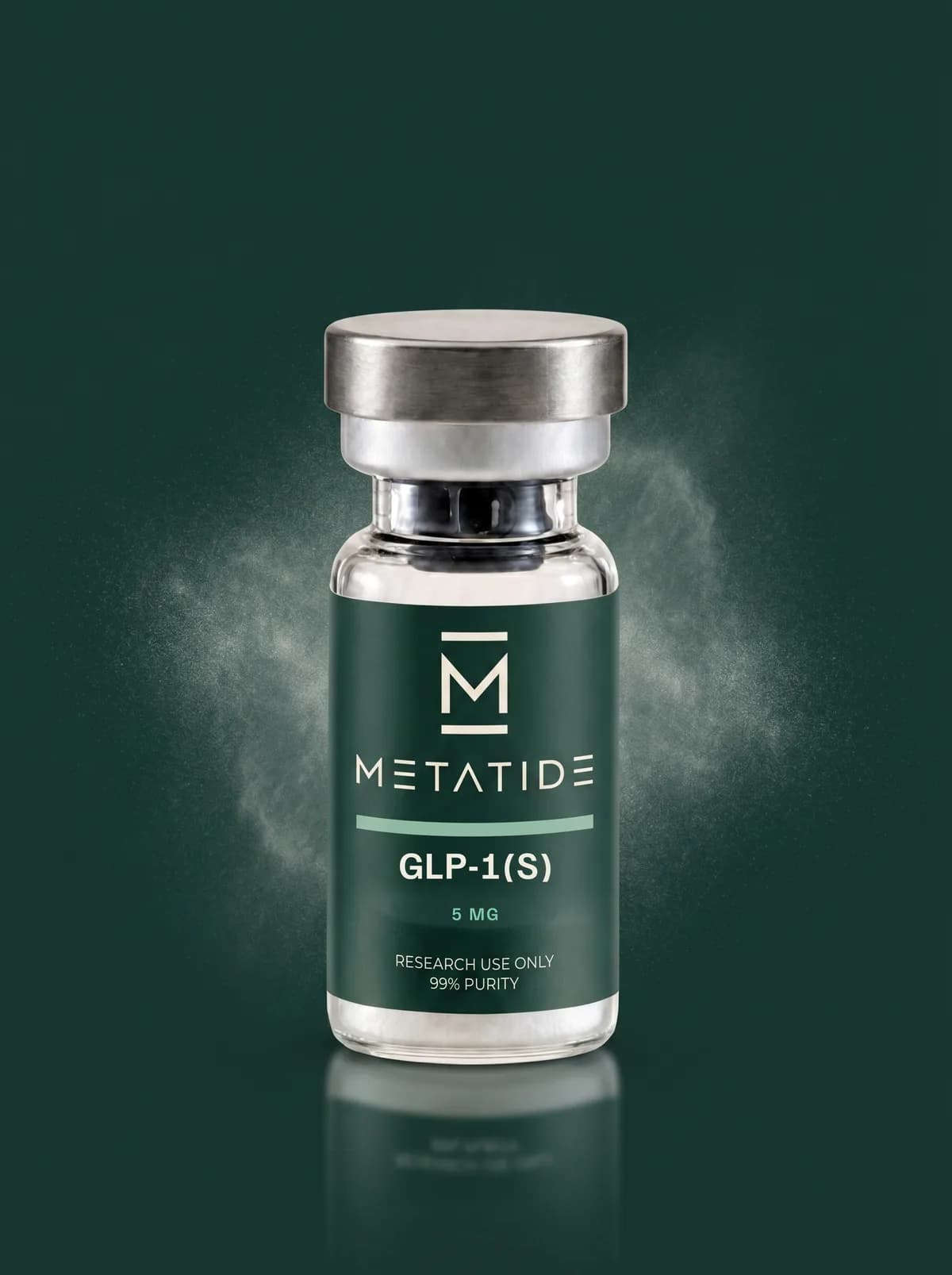
GLP-1(S) is a synthetic GLP-1R agonist. The catalog lists a molecular weight of 4113.58 g/mol, a formula of C187H291N45O59 and a CAS entry of 910463-68-2. The catalog describes it as the established research standard for long-acting GLP-1R agonism, receptor internalization kinetics and beta-cell cAMP signaling characterization.
The mass difference between the two entries, roughly 776 g/mol on the catalog values, reflects the added side chain and the substitutions relative to the native sequence. In practical terms, a mass spectrometry identity check will separate the two cleanly, which is useful when a lab holds both and needs to confirm that a vial is what its label says.
How do the structures differ?
Two structural changes carry most of the difference.
The first is the Aib substitution at position 8. Native GLP-1 has an alanine at that position, and DPP-IV recognizes it. Replacing it with 2-aminoisobutyric acid (Aib), a residue with an extra methyl group, blocks that recognition. The catalog links this change directly to DPP-IV resistance.
The second is the C18 fatty di-acid chain at Lys26. This lipid moiety is what enables reversible albumin binding. In model systems, albumin binding slows clearance and extends the effective lifetime of the peptide, which the catalog expresses as a half-life far extended beyond native GLP-1.
The remainder of the sequence is shared, which is the source of the 94% homology figure. That shared core is why both compounds recognize GLP-1R. The catalog does not list full residue sequences for either compound, so this article does not reproduce them. A researcher who needs the exact sequences should take them from the supplier's certificate of analysis and the published structural literature.
How do their stability profiles compare in assays?
Stability is the main practical axis of comparison.
Native GLP-1 is cleared quickly in systems that contain DPP-IV, and in media with serum components its signal can decay during an incubation. That is a feature in some designs. A lab studying the acute, transient response of the receptor may prefer a ligand that falls away on its own timescale.
GLP-1(S) is built to persist. DPP-IV resistance removes the main enzymatic route of inactivation, and albumin binding creates a reservoir of bound ligand in albumin-containing media. A lab studying prolonged receptor engagement, receptor internalization over longer windows, or desensitization will usually find the stabilised analog more fitting.
There is a subtlety that is easy to miss. Albumin binding changes the free concentration of the ligand in the assay. In a medium with added albumin, the apparent potency of a lipidated analog can shift compared with the same nominal concentration in a medium without it. Reporting the albumin content of an assay buffer is therefore part of making a comparison between the two compounds reproducible.
What do the two compounds each answer experimentally?
Native GLP-1 answers questions about the baseline biology of the receptor. How does the unmodified endogenous ligand bind? What are its association and dissociation kinetics? What cAMP response does it elicit in a given cell line? Those results become the yardstick for everything else.
GLP-1(S) answers questions about how a modified ligand departs from that yardstick. Does the lipid chain alter binding kinetics? Does it change the rate of receptor internalization? Does the cAMP response persist longer? The catalog identifies receptor internalization kinetics and beta-cell cAMP signaling as the characterization areas where it serves as a standard.
Running both in the same experiment is the cleanest design. The native peptide anchors the assay, the analog shows the effect of the modifications, and a vehicle control confirms that neither readout is an artifact of the buffer.
What is known and what is not?
Several things can be said with confidence from the catalog alone: the shared target, the three structural differences, the identifiers and masses, and the stated roles of each compound in receptor pharmacology work.
Some things should not be stated from the catalog alone. It does not give residue-by-residue sequences, so a position-by-position comparison cannot be built from it. It does not give measured binding affinities, EC50 values, or half-life numbers, so this article gives no numbers for them. Quantitative comparisons belong in the published pharmacology literature and in a lab's own side-by-side measurements, where assay format, cell line and receptor expression level all affect the result.
It is also worth being careful about analogies. The fact that the two compounds share a receptor does not mean they produce identical signaling. Ligand modifications can change bias between Gs-cAMP signaling and beta-arrestin recruitment, and whether that happens here has to be measured in the system of interest.
How do both fit into the wider incretin catalog?
Both compounds are single-receptor GLP-1R agonists, which makes them the reference point for the multi-receptor tools. GLP-3(R) is described in the catalog as a triple agonist acting at GLP-1R, GIPR and the glucagon receptor, with fatty acid conjugation for albumin binding. A lab investigating what the added receptor arms contribute will often use native GLP-1 and a single-target analog like GLP-1(S) as the baseline conditions, then add the multi-receptor compound to see what changes.
Seen that way, the pair forms a ladder. Native GLP-1 is the unmodified reference, GLP-1(S) is the stabilised single-target reference, and the dual and triple agonists extend the receptor profile. Each step changes one thing, which is what makes the comparisons interpretable.
Research use disclaimer
All compounds referenced in this article are supplied for laboratory research use only. They are not intended for human or veterinary use, and nothing here describes or implies any use outside in vitro and other controlled research settings. Statements about each compound reflect catalog descriptions and general receptor pharmacology, and should be verified against primary literature and supplier analytical documentation. For research purposes only.