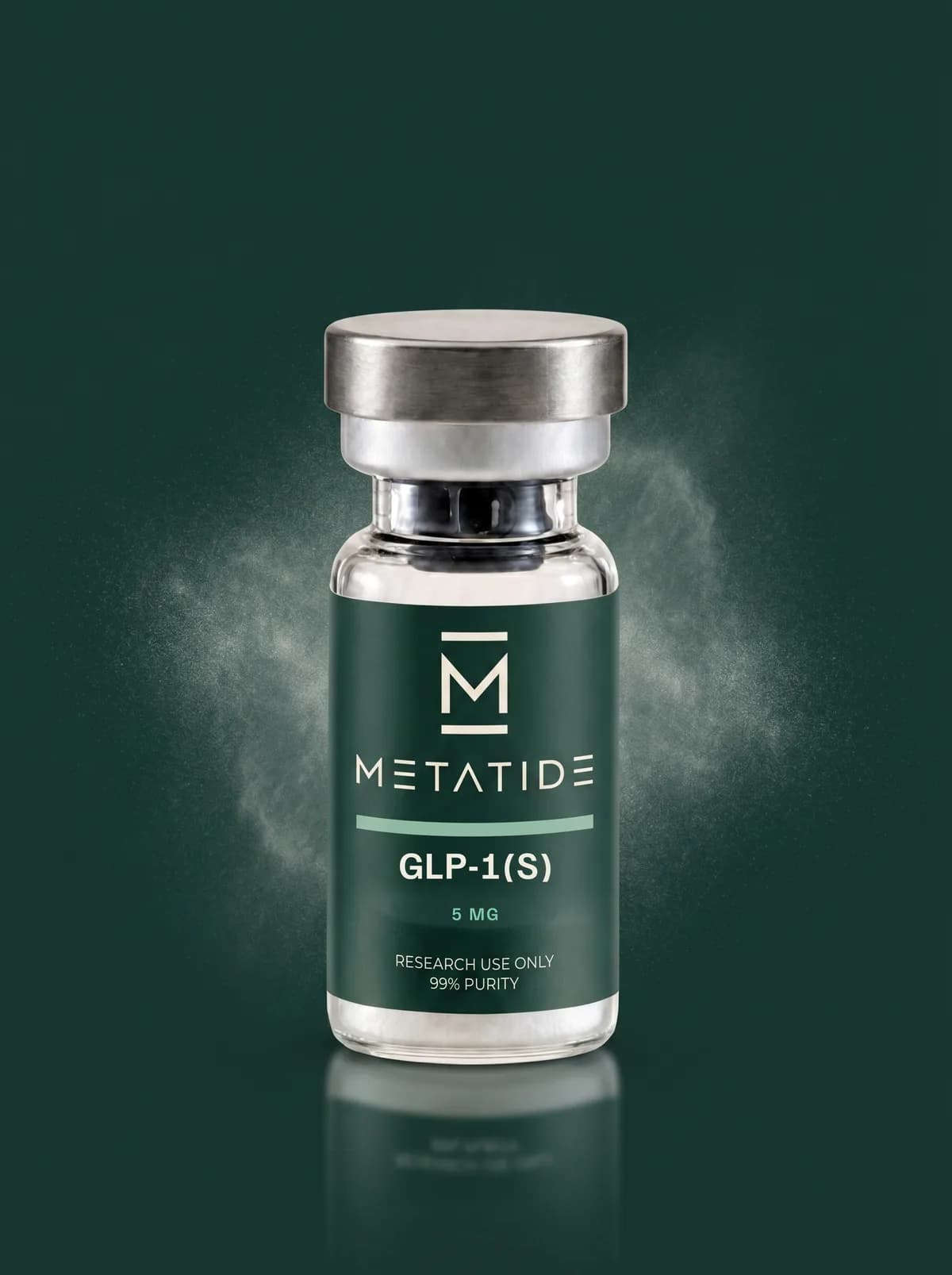
GLP-1(S) is a synthetic lipidated analog of glucagon-like peptide-1 (GLP-1) studied in research for its agonist activity at the GLP-1 receptor (GLP-1R). It is catalogued under CAS number 910463-68-2, with a molecular formula of C₁₈₇H₂₉₁N₄₅O₅₉ and a molecular weight of 4113.58 g/mol. The compound is supplied as a lyophilized powder for laboratory research use and is not intended for human use.
Among the incretin-class research compounds, GLP-1(S) represents the lipidated single-target GLP-1R agonist — a molecule engineered to engage the GLP-1 receptor with extended pharmacokinetic stability relative to the native GLP-1 peptide. Two structural modifications distinguish it from native GLP-1: an amino acid substitution that confers resistance to degradation by dipeptidyl peptidase-4 (DPP-4), and a fatty acid side chain attached to the peptide backbone that promotes albumin binding and dramatically extends circulating half-life in pharmacokinetic models.
These two modifications together make GLP-1(S) the most pharmacologically distinct member of the GLP-1R agonist research class relative to its native peptide template. Understanding each modification — and what it contributes to receptor engagement dynamics — is central to interpreting research data generated with this compound. For a broader view of how GLP-1(S) fits within the incretin-class research compound category, see The Incretin Research Compound Category in 2026.
What is GLP-1(S)'s molecular structure?
GLP-1(S) has a molecular weight of 4113.58 g/mol and the molecular formula C₁₈₇H₂₉₁N₄₅O₅₉. Its architecture derives from the GLP-1(7-37) or GLP-1(7-36) amide peptide backbone — the biologically active form of glucagon-like peptide-1 — with two targeted structural modifications applied to extend pharmacological utility in research models.
The first modification is a single amino acid substitution at position 8, replacing alanine with α-aminoisobutyric acid (Aib). Position 8 is the DPP-4 cleavage site on native GLP-1 — the position where the enzyme makes its primary cut and rapidly inactivates the peptide in biological systems. The Aib substitution sterically blocks DPP-4 recognition without disrupting GLP-1R binding, conferring resistance to enzymatic degradation. This substitution is the reason GLP-1(S) retains receptor binding activity in assay systems that would rapidly inactivate native GLP-1.
The second modification is lipidation: a C18 fatty diacid is attached to the peptide backbone at lysine 26 via a short polyethylene glycol linker. This fatty acid side chain drives the compound's principal pharmacokinetic feature. Fatty acid-modified peptides bind reversibly to serum albumin in in vivo and ex vivo model systems; because albumin-bound peptide is not available for renal filtration, the effective circulating half-life of the compound extends dramatically — to approximately seven days in relevant research models, compared to minutes for native GLP-1 in the same systems.
The research-grade material is characterized to 99%+ purity or higher by HPLC and is supplied as a white to off-white lyophilized powder. Storage at −20°C is required to maintain structural integrity.
What receptor does GLP-1(S) target?
GLP-1(S) is a selective agonist at the glucagon-like peptide-1 receptor (GLP-1R). The GLP-1 receptor is a class B G-protein-coupled receptor expressed across multiple tissue types relevant to metabolic signaling research: pancreatic beta cells, hypothalamic and brainstem regions involved in energy regulation circuitry, gastrointestinal L-cells, cardiac tissue, and peripheral tissues including skeletal muscle and kidney.
Activation of GLP-1R by an agonist triggers Gs protein coupling, which drives adenylyl cyclase activation and elevation of intracellular cyclic AMP (cAMP). Downstream consequences of cAMP elevation at GLP-1R include protein kinase A activation and exchange protein activation, both of which regulate cellular signaling cascades studied in the context of pancreatic beta-cell function, cardiomyocyte response, and neuronal signaling. The receptor is also capable of signaling through β-arrestin pathways at higher ligand concentrations, and research examining the GLP-1R signaling bias between G-protein and arrestin pathways is an active area of GPCR pharmacology.
GLP-1(S) does not target GIPR or GCGR to a meaningful degree — it is studied as a single-target GLP-1R research compound. This selectivity makes it appropriate as a reference compound in studies designed to isolate GLP-1R-mediated signaling from dual-receptor or triple-receptor effects, and as a baseline against which dual agonists like Mazdutide can be compared.
What is the significance of GLP-1(S)'s lipidation in receptor research?
The fatty acid modification on GLP-1(S) affects receptor research in two distinct ways: it changes the compound's pharmacokinetic profile, and it may alter the receptor binding kinetics relative to unmodified GLP-1 analogs.
On the pharmacokinetic side, the albumin binding driven by the C18 fatty diacid creates a depot effect in in vivo research models. Rather than acting as a transient concentration followed by rapid clearance, GLP-1(S) operates as a sustained-release ligand: the free (unbound) fraction maintains receptor engagement over an extended period as albumin-bound compound equilibrates to the free pool. This property makes GLP-1(S) relevant for extended-duration research models and for studies examining sustained versus transient GLP-1R engagement.
On the binding kinetics side, the lipid modification adds significant molecular bulk to the peptide — the compound's molecular weight of 4113.58 g/mol is substantially higher than the approximately 3338 g/mol of unmodified GLP-1 (7-37). This bulk may influence the diffusion rate to the receptor binding site and the kinetics of receptor association and dissociation. Published research characterizing GLP-1(S) receptor binding typically reports both receptor occupancy (EC₅₀) and kinetic binding parameters (Kₐ and K_d) to distinguish it from the unmodified peptide.
For concentration-response studies examining GLP-1R activation, the sustained-release pharmacokinetic profile means that GLP-1(S) and native GLP-1 are not interchangeable controls — they produce equivalent receptor targets but different temporal activation profiles, which matters in cell-based assay designs that involve extended incubation periods.
How does GLP-1(S) compare to unmodified GLP-1 in research models?
The most important differences between GLP-1(S) and unmodified GLP-1 in research applications are pharmacokinetic rather than pharmacodynamic. Both compounds activate GLP-1R through the same fundamental mechanism — Gs coupling, cAMP elevation, downstream kinase activation — and neither has activity at GIPR or GCGR at research concentrations. The receptor they engage and the signaling it initiates are the same.
Property
Native GLP-1 (7-37)
GLP-1(S)
CAS
106612-94-6
910463-68-2
Molecular weight
3337.73 g/mol
4113.58 g/mol
DPP-4 stability
Rapidly cleaved at position 8
Resistant (Aib substitution at position 8)
Albumin binding
Minimal
High (C18 fatty acid moiety)
Circulating half-life (model)
Minutes
~7 days
Receptor target
GLP-1R
GLP-1R
The practical consequence of these differences is that GLP-1(S) is the appropriate compound when research requires sustained GLP-1R engagement over an extended period — in extended-exposure model systems, chronic incubation studies, or pharmacokinetic profiling experiments. Native GLP-1 or short-acting analogs are more appropriate for acute, short-duration receptor activation studies where prolonged receptor occupancy would confound results.
What does published research describe about GLP-1(S)'s receptor pharmacology?
Published research on GLP-1(S) is organized around three primary questions: receptor binding affinity and kinetics, downstream cAMP signaling in GLP-1R-expressing cell lines, and the pharmacokinetic profile in preclinical models.
Receptor binding studies characterize GLP-1(S) at recombinant GLP-1R using radioligand displacement assays or HTRF-based competition binding, with IC₅₀ and Ki values reported as the primary binding metrics. Functional studies in cAMP accumulation assays — typically in HEK293 cells or CHO cells stably expressing human GLP-1R — characterize the potency of GLP-1R activation through concentration-response curves, expressed as EC₅₀. These studies consistently place GLP-1(S) in the sub-nanomolar range for GLP-1R activation in cell-based assay formats.
Pharmacokinetic studies in rodent and primate models document the albumin binding-driven extension of circulating half-life relative to native GLP-1. These studies form the basis for the extended-acting classification of the compound in the research literature.
All findings should be framed within the mechanistic context appropriate for a research compound: receptor pharmacology, signaling pathway characterization, and pharmacokinetic profiling in model systems. Metatide does not make therapeutic claims regarding GLP-1(S); it is supplied for receptor pharmacology and related laboratory investigation only.
How does GLP-1(S) fit within the broader incretin compound research category?
Within the incretin-class compound spectrum, GLP-1(S) represents the single-receptor, lipidated end. Its defined GLP-1R selectivity and well-characterized pharmacokinetic profile make it a useful reference point in studies examining what additional receptor targets contribute to signaling models.
Researchers building concentration-response panels that include dual agonists such as Mazdutide or triple agonists such as GLP-3(R) typically include GLP-1(S) as the single-target GLP-1R reference — the compound that isolates GLP-1R activity from the additional GCGR or GIPR contributions present in the multi-target compounds. This comparative experimental design requires that GLP-1(S) be characterized to the same analytical standard as the multi-target compounds in the panel.
What stability and handling considerations apply to GLP-1(S)?
GLP-1(S) is stored at −20°C in its lyophilized form. The two structural features that make it pharmacologically useful — the Aib substitution and the fatty acid lipidation — also determine its primary degradation pathways.
The lipid modification is the more sensitive element: the fatty acid attachment site is susceptible to hydrolysis under aqueous conditions and oxidative degradation under poor storage conditions. As with other lipidated peptides, purity testing alone may not detect lipid-specific degradation; mass spectrometry confirms that the molecular weight corresponds to the intact lipidated compound rather than a lipid-loss degradation product.
The Aib substitution, while conferring DPP-4 resistance, does not alter the compound's general peptide sensitivity to temperature-driven aggregation or deamidation. Standard lyophilized peptide handling protocols — avoiding repeated freeze-thaw, minimizing moisture exposure — apply.
How does Metatide supply GLP-1(S)?
Metatide supplies GLP-1(S) as a research-grade compound held to a 99%+ minimum purity specification by HPLC, with mass spectrometry identity confirmation included in the batch-specific Certificate of Analysis. Endotoxin testing is conducted per batch.
Specifications, available sizes, and pricing are on the product page for GLP-1(S). Related compounds in the metabolic signaling category — including GLP-3(R) — are available through all compounds. All material is for laboratory research use only — not for human use.
GLP-1(S) is a research chemical intended for laboratory and scientific research purposes only. Not for human use. It is not a drug, supplement, or food, and is not intended to diagnose, treat, cure, or prevent any disease. Metatide does not sell products intended for human consumption. Researchers are responsible for compliance with all applicable local, state, and federal regulations.